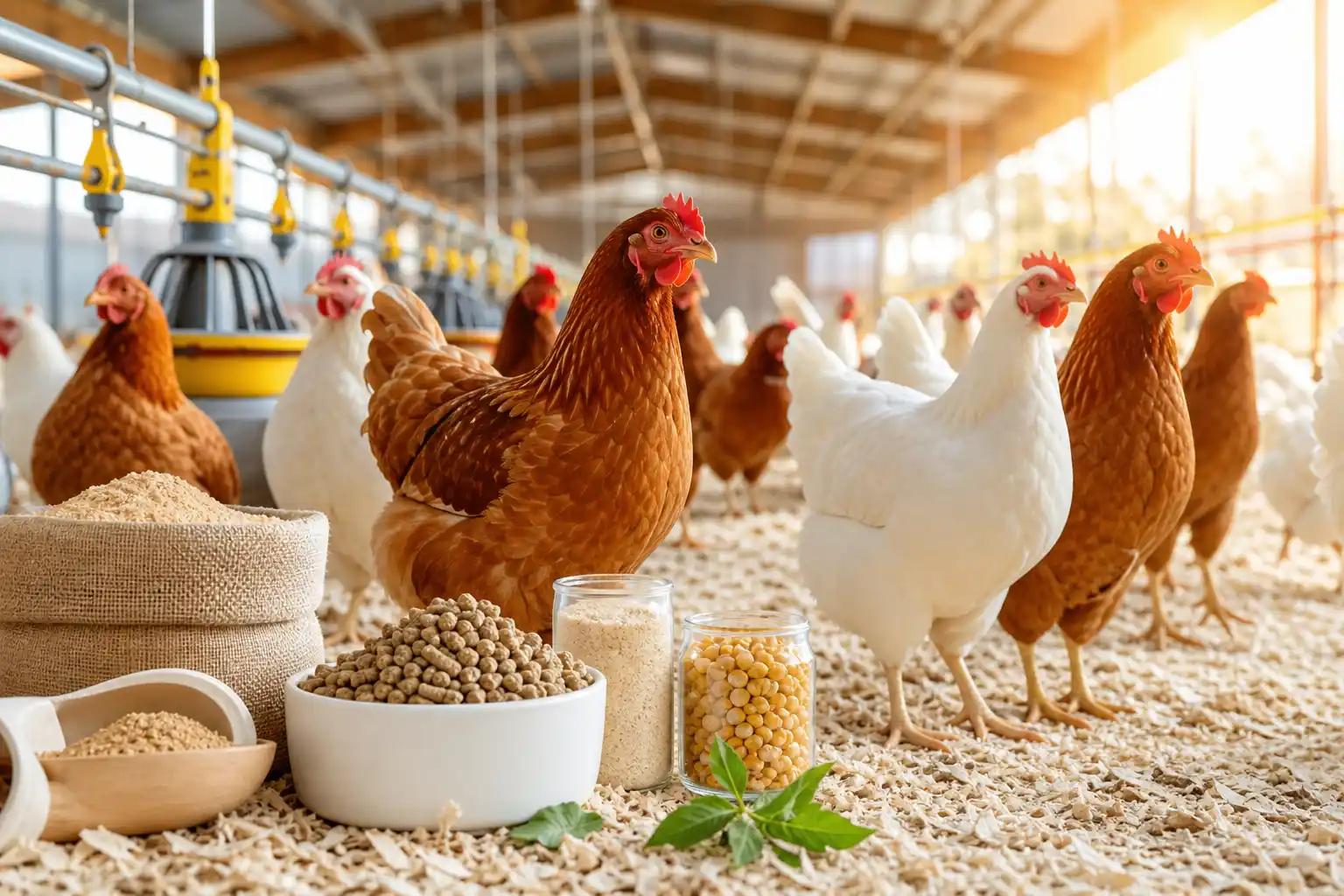
Poultry Feed Supplement Manufacturing: From Concept to Finished Product
The manufacturing process for poultry feed supplements is more sophisticated than most producers realize. I’ve spent years working with supplement manufacturers and have a deep appreciation for what goes into a quality product. The difference between a good supplement and a bad one often comes down to manufacturing quality.
Raw Material Selection
The quality of a supplement starts with its ingredients. A reputable manufacturer sources raw materials from approved suppliers who provide certificates of analysis for every batch.
Key raw materials:
- Vitamins. Most commercial vitamins are synthetic. The major global producers include BASF, DSM, and Adisseo. Their products have consistent quality. Smaller or regional suppliers may have more variability.
- Trace minerals. Inorganic forms (sulfates, oxides) are economical and widely available. Organic chelates (methionates, glycinates) cost more and provide higher bioavailability.
- Carriers. The carrier (also called filler) makes up 50-80% of a premix. Ground corn cobs, rice hulls, wheat middlings, and calcium carbonate are common carriers. The carrier should be free-flowing and stable.
Premix Manufacturing Process
The basic steps in premix manufacturing are:
1. Raw material verification. Every incoming ingredient is sampled and tested. This includes vitamin potency assays, mineral analysis, and physical testing (particle size, flowability).
2. Grinding. If needed, ingredients are ground to a uniform particle size. Uniform particle size prevents segregation during mixing.
3. Weighing. Ingredients are weighed to precise specifications. A typical premix may contain 20-40 different ingredients. The weighing accuracy should be within 1% for major ingredients and 0.1% for micro-ingredients like selenium.
4. Mixing. The ingredients are blended in a batch mixer. Ribbon mixers and paddle mixers are common. The mixing time must be optimized: too short, and the mix is non-uniform; too long, and particle segregation can occur. The industry standard coefficient of variation for mixing is less than 10%.
5. Quality control testing. Samples from each batch are tested for key nutrients. A complete feed premix analysis typically covers: vitamin A, D3, E, B2, selenium, copper, and the carrier.
6. Packaging. The finished premix is packaged in bags or bulk containers. Multi-wall paper bags with a plastic liner are standard. Vacuum sealing is used for products requiring maximum stability.
7. Labeling. Every package is labeled with the product name, guarantee analysis, batch number, manufacture date, and expiration date.
Quality Control
In a well-run premix plant, quality control is non-negotiable. The QC lab should have:
- HPLC for vitamin analysis
- Atomic absorption or ICP for mineral analysis
- NIR for rapid screening of incoming ingredients
- Wet chemistry methods for verification
- Microbiological testing for mold and bacterial counts
I visit supplement manufacturing plants regularly. The ones I trust have clean facilities, good record-keeping, and real quality control programs. The ones I avoid have dirty facilities, missing records, and QC that consists of “the supplier’s analysis looks good.”
Common Manufacturing Problems
Segregation. Different particle sizes separate during handling. This is the most common cause of variability in finished feed. Good manufacturing minimizes particle size differences between ingredients.
Cross-contamination. Residues from one product can contaminate the next batch. This is a particular concern with medications. Proper flushing between batches is essential.
Moisture pickup. Some ingredients are hygroscopic (they absorb moisture from the air), causing caking and reduced flowability. Packaging and storage must protect against moisture.
Vitamin degradation. Heat, moisture, and mineral interactions degrade vitamins during storage. Proper formulation (including overages), packaging, and storage minimize this.
Scale of Production
Premix plants range from small batch operations producing 500 kg batches to fully automated plants producing 10-20 tons per hour. The scale affects cost and consistency.
Large plants benefit from:
- Lower cost per ton (economies of scale)
- More consistent product (automated systems)
- Better quality control (dedicated labs)
- More stable supply
Small plants offer:
- More flexibility for custom formulations
- Faster turnaround for small batches
- Ability to handle specialty ingredients
Working with a Manufacturer
If you’re developing a custom supplement, here is what you need:
- A clear specification (what nutrients, at what levels, in what form)
- A target price point
- Expected volume and delivery schedule
- Quality testing requirements
- Packaging requirements
I recommend getting quotes from 2-3 manufacturers and comparing not just price but also quality programs, technical support, and delivery reliability.
The cheapest supplement is rarely the best value. A $500/ton premix that is 20% below guaranteed analysis is a worse deal than a $700/ton premix that meets every specification.